Infrared Sauna and Mitochondrial Health: Understanding the Connection
Rachelle Reed, Phd, MS
September 1, 2026
Infrared Sauna and Mitochondrial Health: Understanding the Connection
Every cell in your body needs energy, and your mitochondria help make it happen.
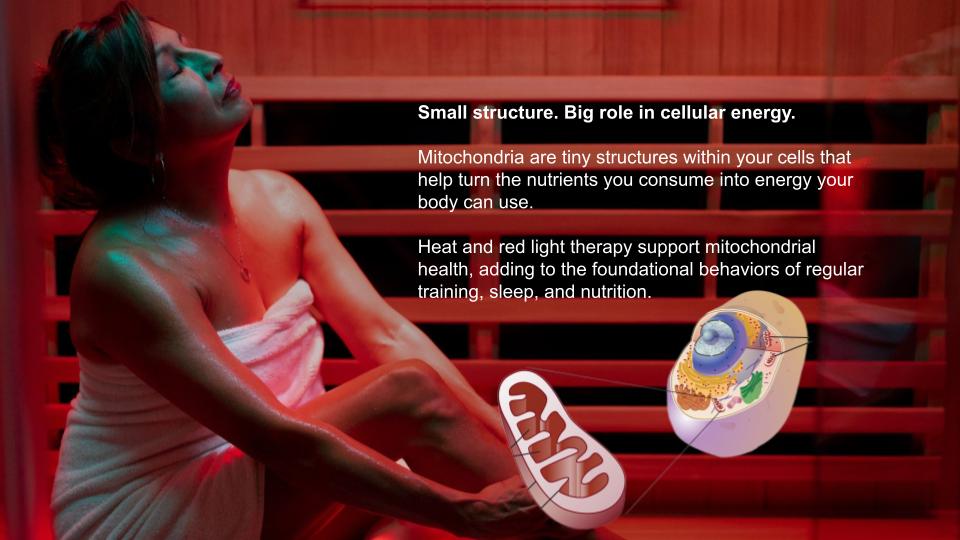
You may remember mitochondria from biology class as the “powerhouses of the cell” – and for good reason. These cellular organelles (tiny structures found within your cells) help turn the nutrients you consume into energy your cells can use [1]. But mitochondria are also dynamic, responding to the demands you place on your body.
Exercise is one of the best known examples. Regular physical activity can stimulate mitochondrial biogenesis, the process through which cells produce new mitochondria, and promote other mitochondrial adaptations [2, 3]. But exercise isn’t the only physiological stressor that may influence these cellular responses. Heat is one too.
That connection has sparked growing interest in infrared sauna and mitochondrial health. Infrared sauna uses near-, mid-, and far-infrared wavelengths to create a heat stimulus that prompts a range of physiological responses. Emerging research suggests that heat exposure may also influence cellular pathways involved in mitochondrial health and adaptation.
And there’s another layer to the story. Red light therapy, which can be paired with infrared sauna during a Perspire session, is also being studied for its potential influence on mitochondrial function and cellular energy production.
So, what do we know about infrared sauna, red light therapy, mitochondrial health, and how might they fit alongside the everyday habits that support it? Let’s break it down.
What are Mitochondria? And Why Do They Matter?
Among their many roles, mitochondria have one particularly important job: helping produce adenosine triphosphate (ATP), the primary form of energy cells use to carry out everyday functions. Tissues with high energy demands, like your skeletal muscles, contain especially high numbers of mitochondria [1].
In addition to simply producing energy, mitochondria also play a role in metabolism, cellular signaling, responses to stress, and other processes that help cells function normally [1]. When mitochondrial function becomes impaired, those effects can extend well beyond the cell. Changes in mitochondrial function have been observed with aging and across a range of health conditions [2].
The good news? Mitochondria are responsive, and lifestyle factors like regular exercise training can influence their function and adaptation. A recent systematic review found that exercise induces molecular and structural mitochondrial changes in skeletal muscle, with PGC-1α, an important regulator of mitochondrial biogenesis, among the most consistently studied markers [3].
That ability to adapt is important to understanding why researchers are interested in heat. Like exercise, heat exposure temporarily challenges the body and activates responses designed to help cells handle that stress [4]. This adaptive response to heat provides an important foundation for understanding the emerging research on infrared sauna and mitochondrial health.
How Heat Exposure May Influence Mitochondrial Health
Heat exposure creates a physiological challenge that requires the body to work to maintain its core temperature. As body temperature rises, thermoregulatory responses, including changes in heart rate, circulation, and sweating, help the body manage that added heat [4]. At the cellular level, heat stress can also activate protective and adaptive responses, particularly when exposure is repeated over time [4].
One way researchers explain this response is through hormesis, the process by which a controlled physiological stressor can stimulate adaptations that help the body respond more effectively to future exposures. Exercise is perhaps the most familiar example, but heat can act as a hormetic stressor as well. Repeated heat exposure has been associated with the activation of heat shock proteins (HSPs), which help protect proteins and maintain normal cellular function during periods of stress [4].
Researchers are also beginning to understand how these heat-induced responses may extend to mitochondrial health. In one study, 20 adults received localized heat to the thigh for two hours per day over a 6-day period. Researchers observed increases in PGC-1α—a key regulator of mitochondrial biogenesis, and proteins involved in the mitochondrial electron transport chain. Repeated heating also improved measures of mitochondrial respiratory capacity in skeletal muscle [5].
While this study used localized deep-tissue heating rather than infrared sauna, it provides compelling human evidence that repeated heat exposure can stimulate measurable mitochondrial adaptations. These findings add to our understanding of how the body responds to heat and provide an important foundation for continued research into infrared sauna and mitochondrial health.
Infrared Sauna and Mitochondrial Health: What Does the Research Show?
Research directly examining infrared sauna and mitochondrial health in humans is still emerging. Yet, the evidence we’ve discussed helps connect two important pieces of the story: repeated heat exposure can stimulate pathways involved in mitochondrial adaptation, and infrared sauna can provide the type of physiological heat stimulus that prompts the body to respond [4, 5].
A 2026 study provides useful insight into that second piece. Twelve healthy adults completed a 45-minute far-infrared sauna session at 65°C (149°F). Core body temperature increased by an average of 1.4°C (2.5°F), while heart rate increased from an average of 74 to 153 beats per minute. These findings demonstrate that a far-infrared sauna, when delivered at a sufficient thermal load, can meaningfully increase core temperature and create a substantial physiological response to heat [6].
Taken together, the research provides a promising foundation for understanding the potential connection between infrared sauna and mitochondrial health. We know that repeated heat exposure can influence mitochondrial adaptation, and we know that infrared sauna can create a meaningful heat stimulus. Continued research will help us better understand how consistent infrared sauna use may influence mitochondrial function and adaptation over time.
How Does Red Light Therapy Support Mitochondrial Health?
Red light therapy, also known as photobiomodulation (PBM), uses specific wavelengths of red and near-infrared light to interact with biological tissue. Mitochondria are central to many of the proposed biological responses to photobiomodulation, making red light therapy an area of growing research interest for cellular energy and mitochondrial health [7, 8].
Much of this interest centers on how red and near-infrared light may influence mitochondrial energy production. Research suggests that photobiomodulation may interact with the electron transport chain, which plays an important role in producing ATP, with potential effects on mitochondrial function and cellular signaling [7, 8]. Cytochrome c oxidase has historically been proposed as an important target for these wavelengths, although researchers continue to investigate other mechanisms involved.
Research is also exploring how PBM may influence broader aspects of mitochondrial health, including mitochondrial dynamics, the processes through which mitochondria continually change, divide, and fuse in response to cellular demands [8]. While much of this evidence is still preclinical, it adds to a growing body of research examining the relationship between red and near-infrared light and mitochondrial function.
Together, these findings help explain why red light therapy is being studied in the context of mitochondrial health and cellular energy. At Perspire, red light therapy can be incorporated into an infrared sauna session, providing a light-based stimulus alongside the physiological effects of heat. While the two modalities interact with the body differently, both are part of a growing area of research exploring how heat and light may influence cellular health and adaptation.
Supporting Mitochondrial Health
Mitochondrial health isn’t shaped by any single behavior or modality:
Regular physical activity is one of the most well-established lifestyle strategies for promoting mitochondrial adaptation, including mitochondrial biogenesis in skeletal muscle [3].
Nutrition also influences mitochondrial physiology, including processes related to mitochondrial function, biogenesis, and dynamics [9].
Sleep is part of the picture, too: research supports an important relationship between sleep, metabolism, and mitochondrial biology, although human evidence is more limited than the exercise literature [10].
Together, regular exercise, balanced nutrition, and quality sleep provide important foundations when thinking about mitochondrial health [3, 9, 10]. Infrared sauna and red light therapy may complement these behaviors by providing additional physiological stimuli that interact with cellular processes involved in adaptation and energy production. As the research continues to evolve, these modalities are best considered as part of a broader approach to wellness rather than replacements for foundational habits.
Consistency is an important part of that bigger picture. Many physiological adaptations develop in response to repeated exposure over time, rather than a single workout, sauna session, or other stimulus [3, 5]. Building movement, quality sleep, balanced nutrition, and restorative practices like infrared sauna and red light therapy into a sustainable wellness ritual can help create habits you can return to consistently.
Key Takeaways
Mitochondria are essential for cellular energy. They help produce ATP and support processes involved in metabolism, signaling, and cellular function.
Everyday habits can support mitochondrial health. Regular exercise, balanced nutrition, and quality sleep are important foundations.
Heat exposure may influence mitochondrial adaptation. Research suggests repeated heat exposure can activate cellular responses involved in how mitochondria adapt.
Infrared sauna provides a meaningful heat stimulus. Emerging research is helping us better understand how infrared sauna may fit into the mitochondrial health conversation.
Red light therapy interacts with mitochondrial biology differently. Red and near-infrared light may influence cellular energy production and signaling through predominantly non-thermal mechanisms.
Consistency matters. Infrared sauna and red light therapy may complement exercise, sleep, and nutrition as part of a broader wellness ritual.
Disclaimer: The content in this article is for educational purposes only and is not intended to replace medical advice, diagnosis, or treatment. If you have a medical condition or questions about incorporating infrared sauna into your wellness routine, consult your healthcare provider before getting started.
References
National Human Genome Research Institute. Updated August 31, 2026. Mitochondria. National Institutes of Health. NHGRI — Mitochondria
Reynolds, S. (2025, July 22). Mitochondria and health: Uncovering the many roles that mitochondria play in health and disease. National Institutes of Health. NIH — Mitochondria and Health
Abrego-Guandique, D. M., Aguilera Rojas, N. M., Chiari, A., Luciani, F., Cione, E., & Cannataro, R. (2025). The impact of exercise on mitochondrial biogenesis in skeletal muscle: A systematic review and meta-analysis of randomized trials. Biomolecular Concepts, 16(1), 20250055.
Patrick, R. P., & Johnson, T. L. (2021). Sauna use as a lifestyle practice to extend healthspan. Experimental Gerontology, 154, 111509. https://doi.org/10.1016/j.exger.2021.111509
Hafen, P. S., Preece, C. N., Sorensen, J. R., Hancock, C. R., & Hyldahl, R. D. (2018). Repeated exposure to heat stress induces mitochondrial adaptation in human skeletal muscle. Journal of applied physiology (Bethesda, Md. : 1985), 125(5), 1447–1455. https://doi.org/10.1152/japplphysiol.00383.2018
Jenkins, E. J., Killick, J. A., Grimm, S. R., Davies, S. R., Benson, J. A., Tremblay, J. C., & Stembridge, M. (2026). Far-infrared sauna exposure at 65°C elevates core temperature. Experimental Physiology. Advance online publication. https://doi.org/10.1113/EP094028
Baskerville, R., Krijgsveld, N., Esser, P., Jeffery, G., & Poulton, J. (2023). The effect of photobiomodulation on the treatment of hereditary mitochondrial diseases. Journal of Lasers in Medical Sciences, 14, e41. https://doi.org/10.34172/jlms.2023.41
Trajano, L. A. S. N., Siqueira, P. B., Rodrigues, M. M. S., Pires, B. R. B., da Fonseca, A. S., & Mencalha, A. L. (2025). Does photobiomodulation alter mitochondrial dynamics? Photochemistry and Photobiology, 101(1), 21–37. https://doi.org/10.1111/php.13963
Kyriazis, I. D., Vassi, E., Alvanou, M., Angelakis, C., Skaperda, Z., Tekos, F., Garikipati, V. N. S., Spandidos, D. A., & Kouretas, D. (2022). The impact of diet upon mitochondrial physiology. International Journal of Molecular Medicine, 50(5), 135. https://doi.org/10.3892/ijmm.2022.5191
Melhuish Beaupre, L. M., Brown, G. M., Braganza, N. A., Kennedy, J. L., & Gonçalves, V. F. (2022). Mitochondria’s role in sleep: Novel insights from sleep deprivation and restriction studies. The World Journal of Biological Psychiatry, 23(1), 1–13. https://doi.org/10.1080/15622975.2021.1907723
Your intro session is up to 50% off — a private suite with full-spectrum infrared heat, red light therapy, and personalized enhancements to suit your wellness journey.